3.2 Philippine local governments launch dynamic ways to solve environmental issues
We tend to have mixed views (from” wow “to “worry”) about the performance of LGUs. We see moments of brilliance now and then; we also tend to see more laggards. Having worked with several LGUs on environmental concerns, my hypothesis is that there are 30 % of them are going the extra mile. One of the worries about very good performers is sustainability. (Ref: GOLD Project)
Ideas that inspired us
Forty percent of government revenues go to local governments.
The frontline civil service of LGUs have their ears on the ground.
Perhaps, only 30-40% of LGUs are doing their job, but for those who are doing it, some excel in it (best practices).
Remarkable Local Government Communities
Provincial Governments and communities in Nueva Viscaya, Bohol and Cotabato, Palawan, Capiz, and other city and municipal LGUs
Catalytic projects that helped model the way
Governance and Local Democracy Project; ECOGOV project.
Key Features
The better concept of capacity building for Local Governments actually involves not only the LGU but also its counterpart civil society (NGOs, community organizations) and other key sectors. This is to ensure that devolution is accompanied by participation. Under the GOLD Project, local actors in a locality (LGUs and civil society) went through process of multisectoral consensus building as basis for developing local policies and locally funded programs. It focuses on what can be done now, based on an agreed upon vision (i.e., not to wait for a big loan/grant before acting on local problems). The Technology of Participation (TOP) was a tool used to inspire and enable consensus building among various competing interests in an LGU setting. TOP was also participatory direction setting tool.
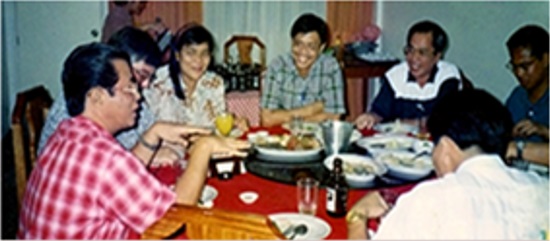
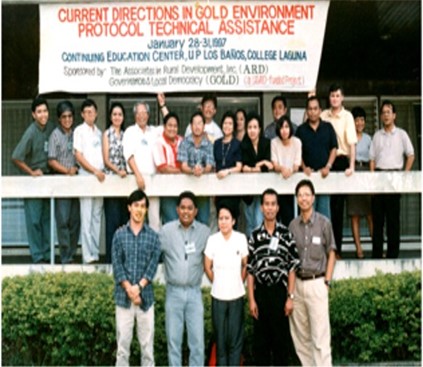
The Governance and Local Democracy (GOLD) was not just about decentralization. It was also about Local Governments or LGUs partnering with citizens (civil society and other sectors) to address their local issues. Thus, the title of the project. The Project GOLD Technical Assistance team above meets the progressive Governor Agbayani of Nueva Viscaya in the mid-1990s.
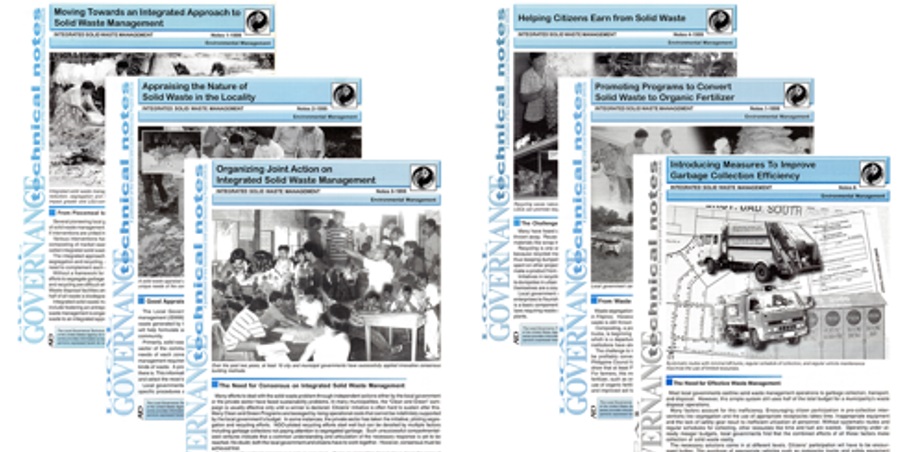
So many immediately doable actions for solid waste management renders costly sanitary landfills almost unnecessary, especially in rural towns.
Highly centralized control of forests (DENR) was one of the keys “Achilles’ hill “of forest management. National government resources are insufficient to provide adequate forest protection. This prompted a thinking to address this dilemma in a politically acceptable way.
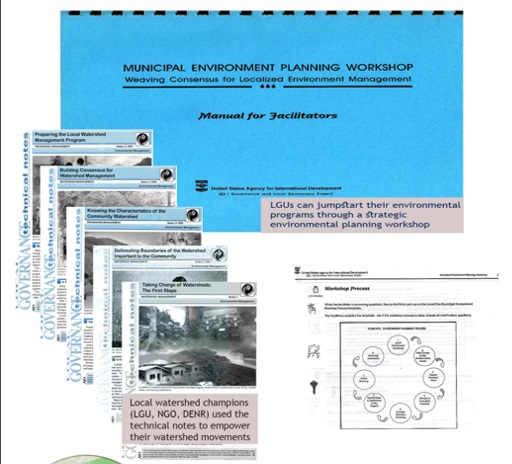
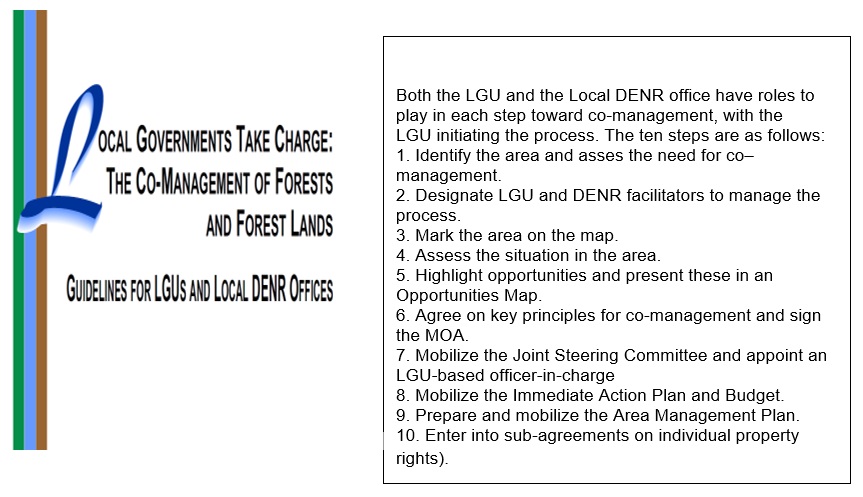
We were thus asked by the ECOGOV Project, to help develop a guide for the DENR and LGUs to share authority to manage forests (above is a list of the steps as part of a booklet). This would incentivize LGU investments for forest protection and management. The system was tried out for a few years. Due to perceived abuses by a few LGUs, the National Government suspended the policy indefinitely on power sharing. In our humble opinion, the alleged abuse should have been addressed and loose ends of the policy fixed, rather than abandon the main idea altogether. This is truly a missed opportunity to engage and tap local resources (human and financial) for forest conservation and management.
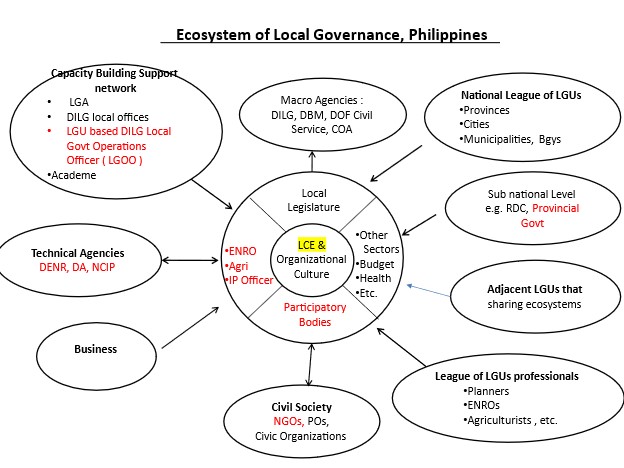
Above is the ecosystem of local environmental governance, with the LGU in the center stage. Within the LGU are key bodies that require differentiated capacity building. The LGU can respond to both vertical and horizontal signals coming from National Agencies, and peer LGUs, community organizations, among others Capacity building can come from different directions. In recent years, peer to peer knowledge sharing among LGUs are promising capacity building modalities. (Ref. this was shared with the Forest Foundation of the Philippines as part of support to the direction on engaging LGUs.)
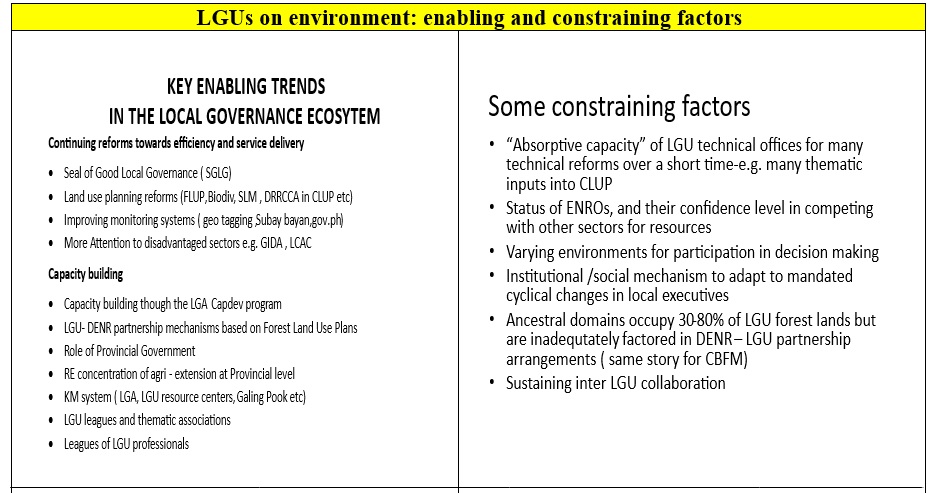
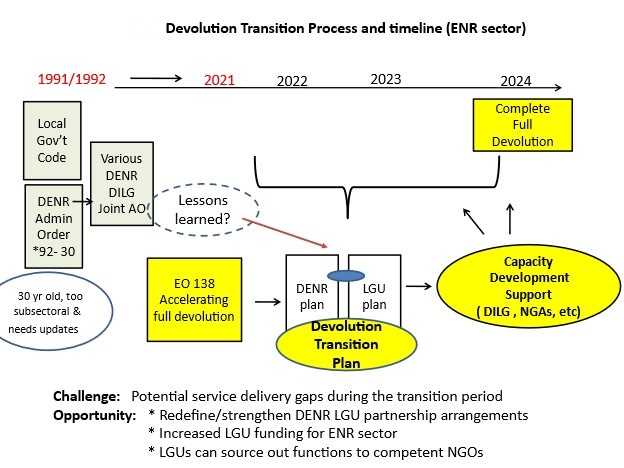
Timeline of milestones that relate to LGUs on environmental issues. There was a brief window (2016- 2022) that tried to accelerate the devolution process. However, this has been suspended.
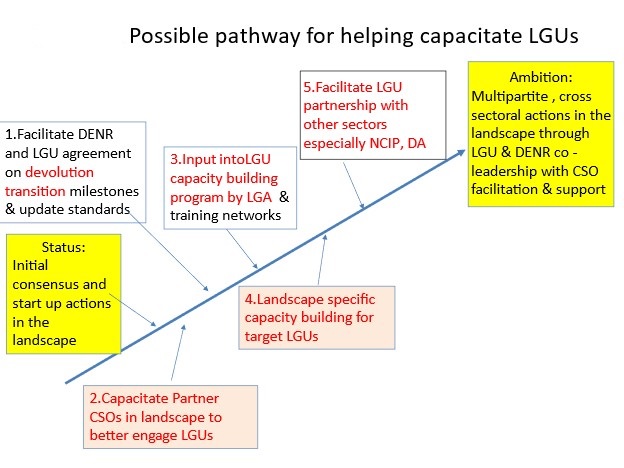
In the environmental front, I believe this could be that pathway for LGU capacity building. The DENR continues to have big role. Peer to peer LGU learning continue to be a promising supplemental pathway
Mentors and Co-travelers
Our work with LGUs covered the Philippines, Cambodia and Indonesia (the latter two is covered in other articles). In the Philippines, our LGU work included that of the Central Visayas Regional Projects in the 80s, the GOLD Project in the late 90s and the EGOGOV project in the 2000s. A deeper understanding of the” science and art “of local governance; and deeper engagement with LGUs happened under the GOLD Project. The following names are most memorable. Governor Nick Agbayani of Nueva Viscaya, Steve, Ken, Paul, Philip, Harry, Rose, Butch, Iting, Nap, Boy, Nards, Jing, Lizette, Rose, Bing, Rudy, Jun, Nick, Rene, Sonny, Vic, Allan, Aim, Elmer, Bebet, Jopet, Lorie, Pong, Joey, Jessica, Jem, Ramon, Raoul, Dan, Bebet Gozun, Gemma. Ernie Guiang, Becky Paz and many more.
Personal Insights
LGUs act usually because of compelling issues (e.g., floods, garbage, crisis). Regrettably seldom do they act for preventive approaches.
To intervene with impact, we need to apply the “bibingka approach”. Bibingka approach means advocacy from above, from below, from the sides and from within.
The Philippine local government code’s “big bang” devolution has not been matched with sufficient capacity building for LGUs. This is the same experience of Indonesia. Resistance to shift from centralized to decentralized approach tend to prevail.
Leagues of LGU based civil servants like local planners. Local ENR offices and local agriculturists can be instrumental in introducing technical and institutional reform building.
Leave a reply